Pollen & Dew
Missouri Botanical Garden · Shaw Nature Reserve · Lafayette Park
Photographed September to October 2026
Made at Missouri Botanical Garden, Shaw Nature Reserve, and Lafayette Park in St. Louis, Pollen & Dew alternates between two tempos of a season on the turn: the motion of bees and the insects and spiders around them, and the stillness of dew held on petals and grass. It ends on time itself, with spent blooms beside full ones and buds beginning to open.
Notes
I went looking for the small events that are easy to walk past: a bumblebee working deep inside a yellow bloom, a jumping spider turning to face the lens, a single drop gathering at the tip of a blade of grass.
Pollen is busy, full of color, appetite and motion. Dew is still, water that has not yet decided to fall. The drops return throughout, a quiet refrain between louder frames, while the middle of the collection gives way to creatures: bees at work, a spider holding its web, an insect keeping watch from a bud.
Pollen & Dew opens with No. 1, the first macro frame I ever made. Everything that follows came after it.
My first macro frame. It is far from perfect. It is still my favorite.
The places
The Garden & the Reserve
Henry Shaw opened the Garden in 1859, making it one of the oldest botanical gardens in continuous operation in the United States. Its Climatron, opened in 1960, was the first geodesic dome ever used as a conservatory.
By the 1920s, coal smoke over St. Louis was harming the Garden’s orchids and conifers. In 1925 it bought 1,300 acres of countryside at Gray Summit as a refuge for them. That land became Shaw Nature Reserve.
The Reserve now covers more than 2,400 acres of reconstructed tallgrass prairie, glades, wetlands and woodland reaching down to the Meramec River. In 1972 it was named a National Environmental Education Landmark.
Lafayette Park
Lafayette Park was set aside from the city’s common fields in 1836 and dedicated in 1851 as the first public park in St. Louis. Many historians consider it the oldest public park west of the Mississippi.
Victorians rode swan boats around its lake, past a grotto and a rockery of sparkling quartz laid in 1866. The park’s 1876 music pavilion was wrecked by the tornado of 1896; a second bandstand rose on the surviving base and stood until 1951.
St. Louis,
up close
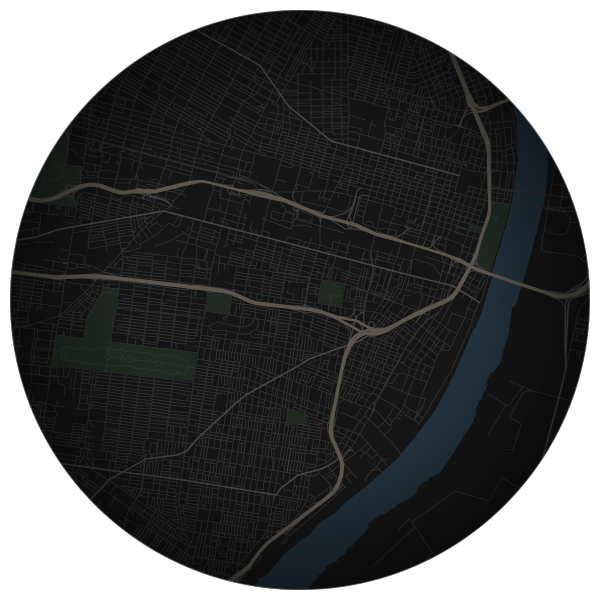
The Garden’s 79 acres sit in south St. Louis. Lafayette Park, about 30 acres, lies roughly 2½ miles east, near the Mississippi. Shaw Nature Reserve is about 35 miles southwest, at Gray Summit.
Map data: U.S. Census Bureau TIGER/Line; parks © OpenStreetMap contributors
No. 16: the photo that did not make the cut