Regulars
French Quarter · Canal Street · St. Claude Avenue
Photographed spring 2025
Regulars is about the people who keep the streets of New Orleans going: the ones who drive them, perform on them, tend bar beside them and read cards at the edge of them. It was photographed in spring 2025, in and around the French Quarter, from afternoon to after dark.
It opens on a direct stare, a black hat and a fan. Then the street at work: a pedicab driver, a performer upside down in mid-move, a busker with a white dog, a young man on the curb with roses folded from palm fronds. Out on St. Claude Avenue, the door of the Healing Center and the wall beside it carry layers of paint and writing.
Evening comes in on Canal Street with the Saenger Theatre and a streetcar at blue hour, then a bartender framed in a doorway. It ends at a tarot table at dusk, with smoke, the cards and a hand in motion, and a reader who looks straight back.
The places
The Quarter
Jean-Baptiste Le Moyne de Bienville founded New Orleans in 1718 on the ground that is now the French Quarter. For its first decades, the Quarter was the whole city.
Fires in 1788 and 1794, while Spain ruled Louisiana, burned much of the French town. What replaced it was largely Spanish in feel, with deep balconies for shade and courtyards behind the street walls, so the French Quarter looks more Spanish than French.
Lagniappe, a little something extra, came to New Orleans from the Andes: the Quechua yapa, something added, became Spanish la ñapa and then Louisiana French. Mark Twain called it a word worth travelling to New Orleans to get.
Canal Street & St. Claude
The Saenger Theatre opened on February 4, 1927, built to feel like an Italian Baroque courtyard under a ceiling of stars. Hurricane Katrina put 14 feet of water into it in 2005. It reopened in 2013 after a $53 million restoration.
Streetcars first ran on Canal Street in 1861, pulled by horses, and went electric in 1894. Buses replaced them in 1964. The streetcars came back to Canal in April 2004.
The New Orleans Healing Center, a community center, stands at 2372 St. Claude Avenue in the Faubourg Marigny, about a mile from Jackson Square.
The Quarter,
up close
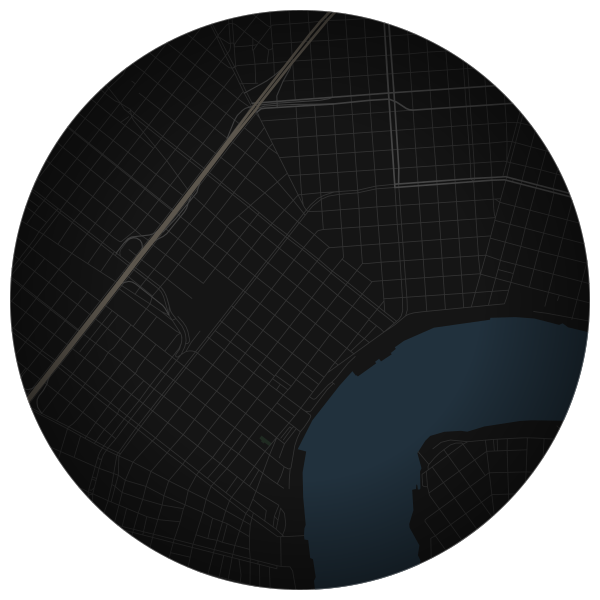
The French Quarter sits on a bend of the Mississippi. Canal Street and Rampart Street are two of its edges, and the Saenger stands where they meet. The Healing Center is about a mile downriver, on St. Claude Avenue in the Marigny.
Map data: U.S. Census Bureau TIGER/Line; Natural Earth
Lagniappe: a little something extra